Making Room for Dessert: A Dietitian’s Guide to Enjoying Sweets

Desserts are meant to be enjoyed. They are part of celebrations, traditions, and everyday moments shared with the people we love. If you have spent any time on Mia’s Eats, you probably already know that I am never going to tell you to eliminate them completely.
I believe desserts can absolutely fit into a balanced eating pattern. The goal is not perfection—it is balance. There is room for both a homemade brownie made with black beans and a slice of birthday cake with extra frosting.
The purpose of this post is not to “healthify” every dessert. Instead, I want to share simple, practical ways to make your favorite treats a little more nourishing when you are baking at home, without sacrificing the flavor and enjoyment that make dessert special.
Why Balance Matters
There is a lot of conflicting information about sugar, which can make eating well feel unnecessarily complicated. Supporting our physical health matters, but so does maintaining a positive and flexible relationship with food. Completely restricting sweets can make them feel even more desirable and, for some people, may contribute to an unhealthy cycle of restriction, overeating, and guilt.
Many of us have experienced an “all-or-nothing” mindset around food. We tell ourselves, “I’ll start fresh tomorrow,” and eat every sweet in sight because it feels like our last opportunity before getting “back on track.” Other times, we deny ourselves the dessert we actually want, try to satisfy the craving with several other foods, and eventually eat the dessert anyway—often past the point of comfortable fullness and with guilt afterward.
Allowing yourself to enjoy the dessert you genuinely want, then moving on, can often be the more balanced and satisfying choice. Dessert does not have to be earned, compensated for, or followed by a plan to “start over.” One cookie, brownie, or slice of cake does not define the quality of your diet. Your overall eating pattern matters far more than any single food or occasion.
Of course, taking a balanced approach does not mean that added sugar is nutritionally irrelevant. Consistently consuming more added sugar than recommended can affect health over time. Added sugar does not need to be feared, but understanding where it shows up and how quickly it can add up can help us make informed choices while still enjoying the foods we love.
Why We Still Talk About Added Sugar
Consistently consuming high amounts of added sugar can:
Make it more difficult to meet nutrient needs if foods high in added sugar regularly replace more nutrient-dense choices
Contribute to excess calorie intake and weight gain over time
Increase the risk of dental cavities
Be associated with a greater risk of conditions such as type 2 diabetes and cardiovascular disease
This is not meant to scare you or make you feel guilty about eating dessert. It is simply about awareness. Instead of eliminating sweets altogether, we can create more balance by:
Adding sources of fiber
Adding sources of protein
Reducing added sugar
Paying attention to our overall eating pattern
How Much Added Sugar is Recommended?
Added sugar recommendations vary somewhat among health organizations, but they all emphasize limiting intake as part of an overall balanced eating pattern.
The American Heart Association (AHA) recommends limiting added sugars to no more than 6% of daily calories, regardless of the source. For most adult women, that is approximately 25 grams, or 6 teaspoons, per day. For most adult men, it is approximately 36 grams, or 9 teaspoons, per day. For children ages 2 and older, the AHA and American Academy of Pediatrics (AAP) recommend less than 25 grams per day, or 6 teaspoons. Children under 2 should not have any added sugars in their diet.
Federal guidance was updated in January 2026. The current Dietary Guidelines for Americans (DGA) advise avoiding added sugars during infancy and early childhood and state that no amount is recommended for children ages 5–10. They also recommend limiting meals to no more than 10 grams of added sugar for adolescents and adults.
These numbers are population-level benchmarks, not pass-or-fail rules for a single meal or day. They can help us understand how quickly added sugars may add up.
To put this into perspective, some single-serve foods and beverages can meet or exceed the recommended daily added sugar limit on their own. For example:
20-ounce regular sports drink: 34 grams of sugar
12-ounce Coca-Cola: 39 grams of added sugar
2.17-ounce package of Skittles: 45 grams of added sugar
This does not mean these products can never fit. Sports drinks, for example, may serve a purpose during prolonged or intense activity. The examples simply illustrate how concentrated sources can provide a substantial amount of added sugar at one time.
Naturally Occurring Sugar vs. Added Sugar
Not all sugar is the same.
Naturally Occurring Sugars:
Natural sugars are found in foods such as:
Fruit
Vegetables
Dairy products
The sugars themselves are not fundamentally different from sugars added to foods. The important difference is the overall nutritional package they come in.
For example, fruit and vegetables provide nutrients such as fiber, vitamins, minerals, and antioxidants. Dairy products provide protein, calcium, and other important nutrients. These foods contribute much more to the diet than sugar alone, which is why naturally occurring sugars in whole foods are viewed differently than added sugars in many packaged sweets and beverages.
Added Sugars:
Added sugars are sugars, syrups, and other caloric sweeteners added during cooking, preparation, or food processing. Examples include:
Cane sugar
Brown sugar
Coconut sugar
Honey
Maple syrup
Agave syrup
Corn syrup
Honey, maple syrup, coconut sugar, and agave are often marketed or perceived as healthier alternatives to table sugar. Although they may contain small amounts of other compounds or nutrients, they still count as added sugar and contribute similarly to overall added sugar intake.
Understanding Sugar Alternatives
Not all sugar alternatives are the same. They differ in their chemical structure, calorie content, effect on blood glucose, and how they appear on the Nutrition Facts label.
High-Intensity Sweeteners:
High-intensity sweeteners, also known as non-nutritive sweeteners, provide sweetness with little to no calories. Some are commonly described as artificial sweeteners, while others are plant-derived. Examples include:
Aspartame
Sucralose
Saccharin
Acesulfame potassium
Stevia, or steviol glycosides
Monk fruit extract
These ingredients are commonly found in products such as diet beverages, sugar-free gum and candies, protein powders, and light ice creams. They are not listed as added sugars on the Nutrition Facts label.
However, “plant-derived” does not automatically mean that a sweetener is more nutritious or beneficial than another. Sweeteners are tools, and whether someone chooses to use them may depend on their preferences, health needs, and tolerance.
Allulose:
Allulose is a little different. Unlike high-intensity sweeteners, it is a type of sugar and is considered a carbohydrate-based sugar alternative. Although it is absorbed by the body, very little is metabolized for energy, which is why it provides significantly fewer calories than table sugar.
Allulose provides approximately 0.4 calories per gram, compared with 4 calories per gram from table sugar. On the Nutrition Facts label, it is included under Total Carbohydrate but may be excluded from Total Sugars and Added Sugars.
Sugar Alcohols:
Sugar alcohols are another group of carbohydrate-based sweeteners. Common examples include:
Sorbitol
Mannitol
Xylitol
Maltitol
Erythritol
Unlike allulose, sugar alcohols are incompletely absorbed by the body. As a result, the unabsorbed portion can be fermented in the large intestine, which may cause gas, bloating, loose stools, or other digestive discomfort when consumed in larger amounts. Individual tolerance can vary.
Many sugar alcohols provide about 2–3 calories per gram, although the exact amount varies by type. They also tend to have a smaller effect on blood glucose than traditional sugar.
Like allulose, sugar alcohols are included under Total Carbohydrate on the Nutrition Facts label, but they are not counted as Total Sugars or Added Sugars. When listed separately, they appear as Sugar Alcohols under the Total Carbohydrate section.
How Fiber and Protein Can Help Balance Dessert
Adding sources of fiber or protein can make a dessert or sweet snack more filling and contribute additional nutrients.
Depending on the ingredients and the dessert as a whole, fiber and protein may help:
Increase fullness and satisfaction
Support a more gradual post-meal blood glucose response
Contribute toward daily protein and fiber needs
Support digestive health and regularity
Add flavor, texture, vitamins, minerals, and other beneficial nutrients
However, adding protein or fiber does not automatically make a dessert “healthy.” A cookie containing 10 grams of protein may still be high in added sugar, saturated fat, or calories.
Rather than judging a food by a single nutrient, consider its overall nutritional profile and how it fits into your broader eating pattern.
Why Portion Size Matters
Portion size is another practical consideration when incorporating desserts into a balanced eating pattern. Larger portions provide more calories and added sugar, so choosing a smaller portion can help you enjoy dessert without overconsuming. Helpful strategies include:
Preparing mini cupcakes, muffins, or other individual desserts
Cutting brownies and sheet cakes into consistent portions
Using a 1-tablespoon scoop to portion cookie dough
Dividing packaged desserts into individual servings
Freezing extra portions to enjoy another time
For packaged products, the serving size on the Nutrition Facts label can also provide a useful reference for understanding how much added sugar and how many calories are in a portion. If you eat more than one listed serving, remember that the nutrient amounts increase accordingly.
Simple Ways to Make Dessert More Nourishing
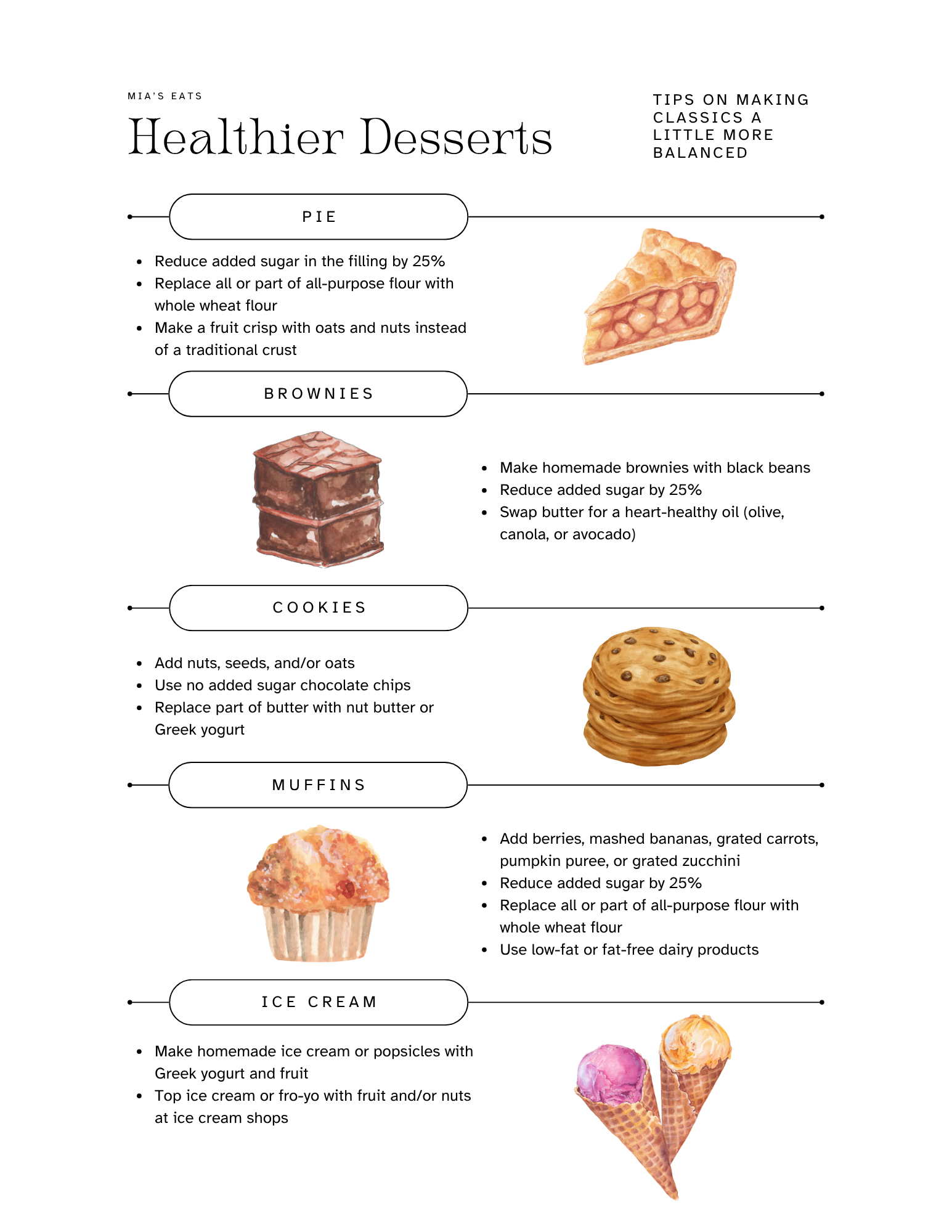
The following ideas can add nutrients or reduce added sugar and saturated fat in homemade treats. Start with small changes and choose the adjustments that make sense for the recipe.
Ingredients to Add:
These ingredients can boost nutrient content, flavor, or texture without necessarily replacing anything in the recipe.
Fruit: berries, bananas, apples
Vegetables: pumpkin, zucchini, carrots
Nuts and seeds: peanut butter, almonds, chia seeds
Whole grains: oats, puffed quinoa
Flavorings and spices: cinnamon, vanilla extract, citrus zest
Ingredients to Adjust:
These swaps can help modify a recipe’s nutrition profile, but they may affect texture, flavor, or structure depending on the recipe.
Reduce added sugar by 25%.
Replace part of the butter with unsweetened applesauce, pumpkin, or mashed banana in moist baked goods such as muffins and quick breads.
Replace melted butter with a heart-healthy oil, such as canola, avocado, or olive oil.
Replace part of the all-purpose flour with whole-wheat flour or oat flour. You can make oat flour by finely blending rolled oats.
Use fewer chocolate chips, replace some with chopped nuts, or try no-added-sugar chocolate chips.
Replace high-fat dairy ingredients, like cream cheese and heavy cream, with plain low-fat dairy products.
A Few Final Tips for Enjoying Dessert
Making dessert more nourishing is only one part of the picture. These are a few additional strategies I use and recommend as a registered dietitian:
Compare Nutrition Facts labels when shopping: When choosing between similar products, select the option with less added sugar when possible. While there is no universal definition for what makes an individual product “low” or “high” in added sugar, the FDA’s % Daily Value guidance can be a helpful tool: 5% DV or less is considered low, while 20% DV or more is considered high.
Pair sweets with a source of protein or fiber: For example, if I am craving chocolate in the afternoon, I might pair it with cheese, vegetables, nuts, or Greek yogurt to create a more satisfying snack plate.
Focus on your overall eating pattern: Not every dessert needs to be modified. There is room for both a Greek yogurt berry parfait and a gooey cinnamon roll on a slow weekend morning. No single food determines the quality of your diet—what you eat consistently over time does.
The Bottom Line
The goal is not to eliminate sweets or turn every dessert into a high-protein, low-sugar version of itself.
Sometimes balance may look like adding fruit, fiber, or protein to a homemade recipe. Sometimes it may mean reducing the added sugar slightly. Other times, it may mean enjoying the original slice of cake, Christmas cookie, or ice cream cone exactly as it is.
As a registered dietitian, I do not believe the goal is perfection or complete sugar avoidance. The goal is to build a flexible eating pattern that supports both your physical health and your relationship with food. Small, realistic changes can make a meaningful difference over time while still leaving room for the foods, traditions, and experiences you genuinely enjoy!
Frequently Asked Questions
Is honey healthier than regular sugar?
Honey contains trace amounts of certain compounds and nutrients, but the quantities are generally too small to make it nutritionally equivalent to a nutrient-dense food. When honey is added to a recipe or product, it still counts as added sugar. It can absolutely be used for its flavor, but it does not need to be viewed as a “free” or unlimited source of sugar.
Are artificial sweeteners safe?
Sweeteners approved by the FDA, or ingredients for which the FDA has generally recognized as safe, are considered safe under their intended conditions of use.
That does not mean everyone needs to consume them. Some people enjoy them as a way to reduce added sugar intake, while others dislike the taste or experience digestive symptoms with certain products. People with phenylketonuria must avoid or restrict aspartame because it contains phenylalanine.
My kids only want sweets. What should I do?
A strong interest in sweets is common among children. Try to avoid presenting dessert as a reward, using it as a bargaining tool, or describing it as forbidden.
Instead, offer sweets calmly and predictably alongside a variety of foods. Keeping the language neutral can help reduce some of the excitement that develops when sweets feel scarce or highly special. If your child’s eating feels extremely limited, stressful, or difficult to manage, consider speaking with a pediatrician or a pediatric registered dietitian.